
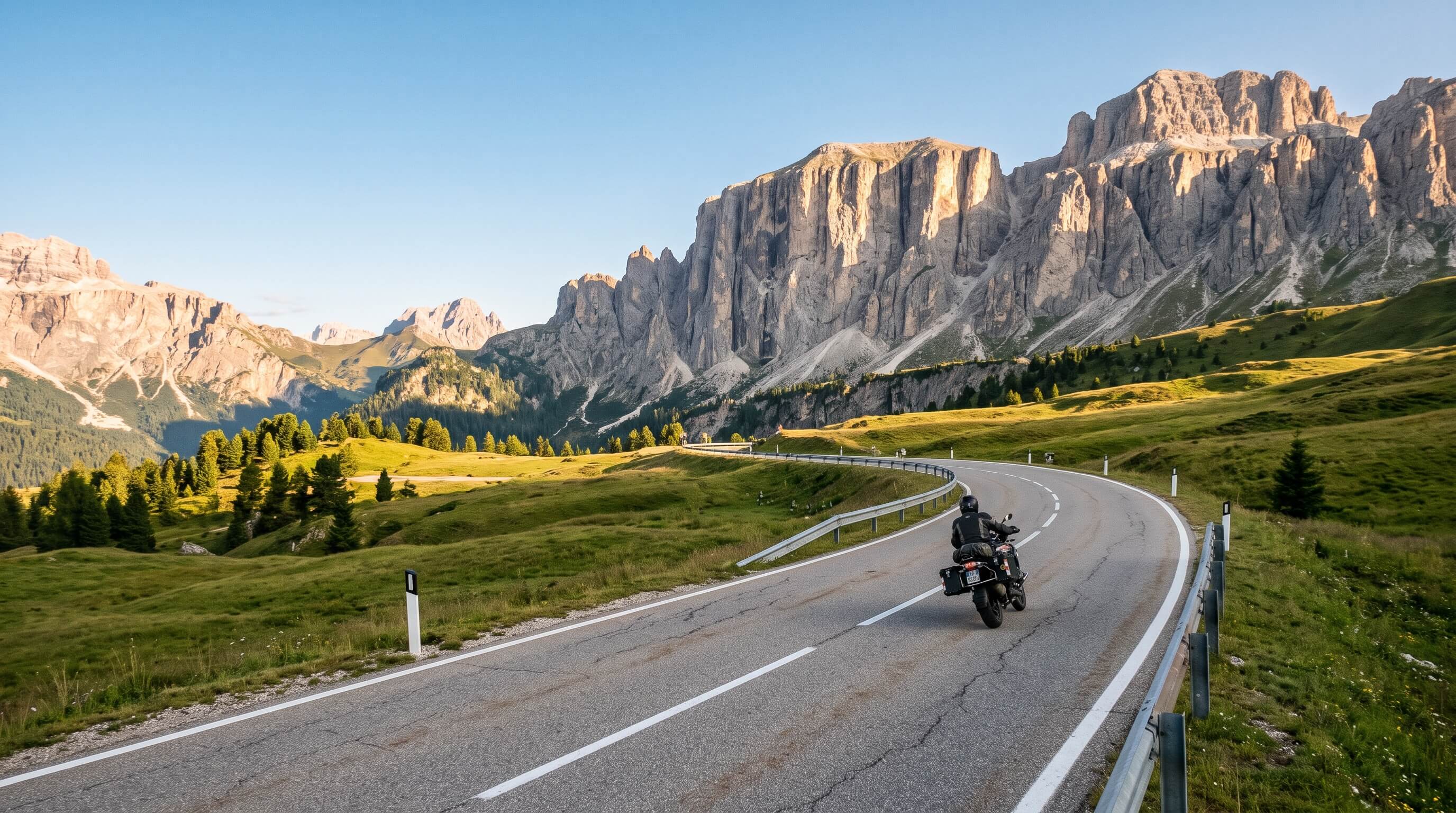
The Italian Highlights: Eight Essential Italian Rides
TFrom Amalfi cliffs to Alpine passes. Eight legendary Italian rides, from the cliff-hugging SS163 Amalfitana to Chianti’s wine roads, the high Alps and the slopes of an active volcano.
Robert
Founder
Italy's roads read like a timeline. Some still carry the names of Roman routes, others were cut into sea cliffs by Bourbon engineers or zig-zagged over Alpine passes for the Habsburg army. Ride them in sequence and you get a lesson in geology, wine, war and state building, delivered one corner at a time.
These eight rides take you from the cliffs of Campania to the high Alps, across two islands and up the flanks of an active volcano. Several of them close for snow, rockfall or roadworks, so always check the current status before you set off.
1. The Cliff Road: SS163 Amalfitana
Route: Meta di Sorrento – Positano – Amalfi – Vietri sul Mare | Region: Campania | Length: about 50 km
The SS163 was built between 1832 and 1850 under the Bourbon Kingdom of the Two Sicilies and was originally dedicated to King Ferdinand II as the Strada Ferdinandea. For the first time it linked coastal towns that had been cut off by the Lattari Mountains on one side and the sea on the other. It only became a state road in 1953.
The ride: The road is narrow, the drops are real and the local buses own the corners. Convex mirrors at blind bends are your best friends, and a quick horn tap before a tight corner is still common practice here. This is not a road for speed; it is a road for spacing, patience and a steady hand.
Worth stopping: Positano for the classic view of houses stacked down the cliff; the Fiordo di Furore, where the road crosses a narrow gorge on a bridge; Amalfi itself; a short detour up to Ravello; and Vietri sul Mare at the eastern end, known for its ceramics.
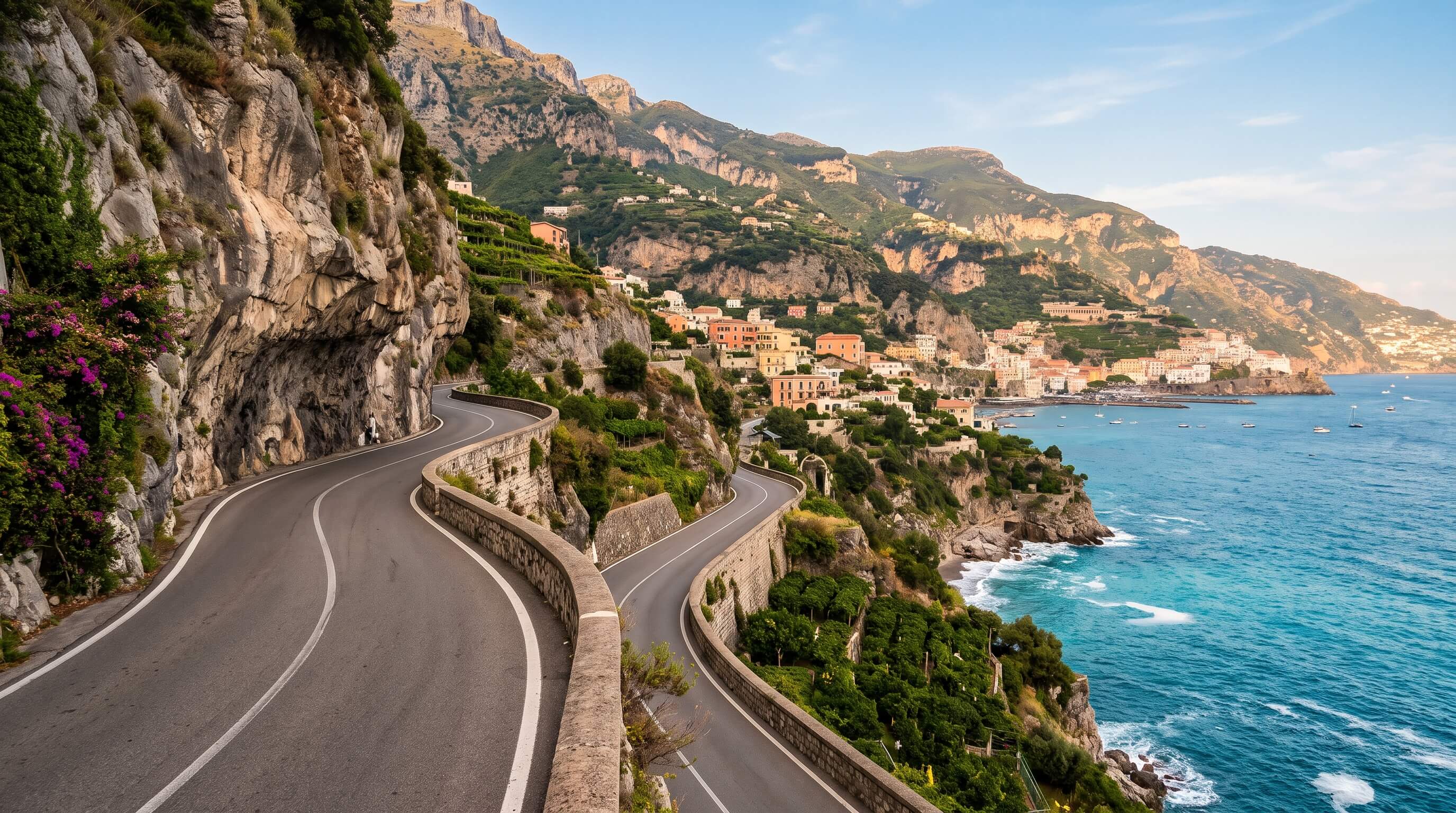
2. The Wine Corridor: SR222 Chiantigiana
Route: Florence – Greve in Chianti – Panzano – Castellina in Chianti – Siena | Region: Tuscany | Length: about 69 km
The SR222 is the classic north-south line through Chianti Classico: flowing bends, cypress avenues, vineyards and olive groves almost all the way. This is a tightly regulated wine landscape under the Chianti Classico DOCG, recognisable by the black rooster (Gallo Nero) on the bottle. The main grape is Sangiovese, and the hills look less like wilderness and more like centuries of careful agricultural design.
Worth stopping: Greve in Chianti, the gateway to the region with its Wine Museum; Panzano; and Castellina in Chianti, founded as a military outpost that Florence and Siena fought over repeatedly. Just before Siena the road passes the hamlet of Fonterutoli. Siena closes the route with the shell-shaped Piazza del Campo at its heart.
3. Into the Postcard: SR2 Via Cassia through the Val d'Orcia
Route: Siena – San Quirico d'Orcia – Bagno Vignoni | Region: Tuscany | Length: about 55 km
From Siena, keep heading south on the SR2, the former state road SS2. It carries the name of the ancient Via Cassia, but not its exact line: the Roman road ran through Arezzo, while today's road runs through Siena. What it does deliver is the Val d'Orcia, a UNESCO World Heritage landscape since 2004 and probably the most photographed farmland in Italy, with rolling hills, lone cypresses and hilltop villages.
Worth stopping: Bagno Vignoni. Its main square, the Piazza delle Sorgenti, is not a square at all but a large 16th-century thermal pool, fed by springs that come out at around 50 °C. Bathing in it is not allowed, but on cool mornings the steam rising over the village is worth the stop alone. The springs have been used since Roman times. For more, Pienza, the Renaissance town also on the UNESCO list, is about 12 km away.
4. The Alpine Classic: The Great Dolomite Road (SS241 and SS48)
Route: Bolzano – Val d'Ega – Lago di Carezza – Passo Costalunga – Canazei – Passo Pordoi – Arabba – Passo Falzarego – Cortina d'Ampezzo | Regions: Trentino-Alto Adige and Veneto | Length: about 110 km
The Grande Strada delle Dolomiti was built between 1901 and 1909. On 13 September 1909 the final section between Arabba and Cortina was opened, completing one of the great tourist roads of the Alps. Strictly speaking it is two roads: the SS241 climbs from just outside Bolzano through the Val d'Ega to the Passo Costalunga, and from Vigo di Fassa the SS48 takes over. In Veneto the SS48 has been downgraded to the regional SR48.
The passes: Passo Costalunga (around 1,750 m), Passo Pordoi (2,239 m) and Passo Falzarego (2,105 m). Between them you get long sweepers, tight hairpins and some of the most dramatic rock walls in Europe.
Worth stopping: Lago di Carezza, a small green-blue lake beneath the Latemar; the top of the Pordoi, where a cable car climbs to Sass Pordoi at 2,950 m and a memorial honours cycling legend Fausto Coppi; and the ruins of Castello di Andraz on the way up to the Falzarego.
Cultural shift: You start in German-speaking South Tyrol, pass through Ladin-speaking valleys such as Val di Fassa, and end in Italian-speaking Veneto. The road signs, the menus and the architecture change with you
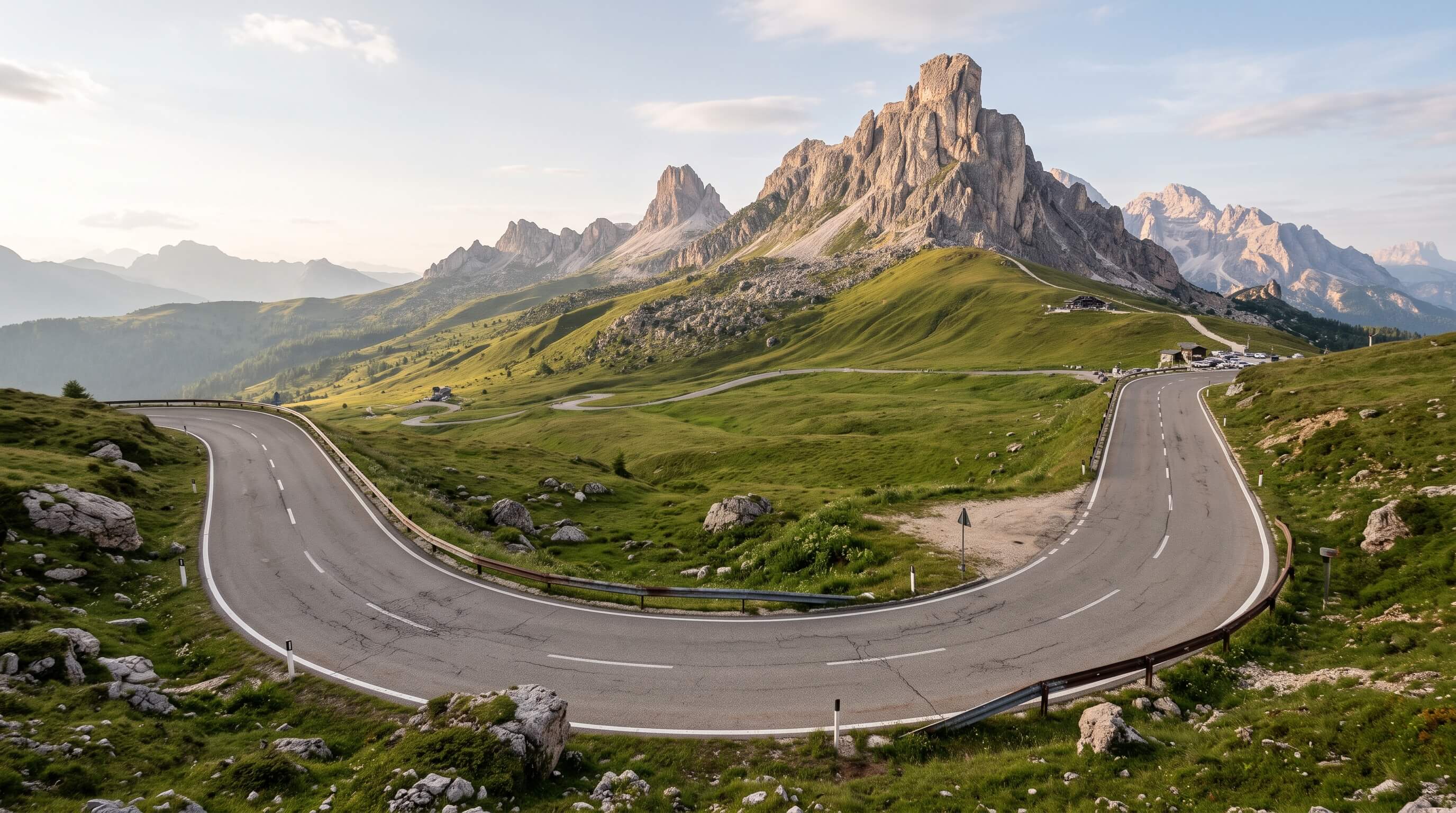
5. The King of Hairpins: SS38 Passo dello Stelvio
Route: Spondigna – Prato allo Stelvio – Trafoi – Passo dello Stelvio – Bormio | Regions: South Tyrol and Lombardy | Length: about 49 km
At 2,757 m the Stelvio is the highest paved pass in the Eastern Alps and the second highest in the whole Alpine chain, just 7 m lower than France's Col de l'Iseran. The Austrian Empire built it between 1820 and 1825 to link its Lombard territory directly with Austria. The engineer was Carlo Donegani, and his line has barely changed in two centuries.
The ride: The north-eastern ramp from Prato allo Stelvio is the famous one: 48 numbered hairpins stacked on top of each other, climbing almost 1,900 m. Many of these switchbacks are tight and steep on the inside, so look well ahead through the turn, pick your gear early and keep steady throttle rather than pulling the clutch mid-corner. The descent to Bormio on the Lombard side is less photographed but just as rewarding. Ride early in the morning to avoid the crowds, and remember that the pass is closed in winter.
Worth stopping: The old Austro-Hungarian fortifications at Gomagoi in the valley below, and the summit itself, with its views over the Ortler group.
6. The Gorge Road: SP38 Strada della Forra
Route: Gardesana Occidentale (SS45bis) – Strada della Forra – Pieve di Tremosine | Region: Lombardy (Lake Garda) | Length: about 6 km
Short, but unforgettable. The Strada della Forra squeezes through the gorge cut by the Brasa stream on the western shore of Lake Garda, climbing from the lakeside to Pieve di Tremosine on its cliff-top plateau. It was opened on 18 May 1913 and ended the isolation of the villages above the lake. In 2008 the film crew of the James Bond movie Quantum of Solace came here for the opening chase sequence.
The ride: Rock tunnels, overhangs and corners so tight that traffic lights regulate the flow. Ride it slowly and look up.
Important: After a landslide in December 2023 the road was closed for 19 months. It reopened on 1 August 2025 with traffic restrictions, and further safety works followed in 2026. Check the current status and the direction of travel before you go.
Worth stopping: Pieve di Tremosine, perched high above the lake, with views straight down to the water.
7. The Island Masterpiece: SS125 Orientale Sarda
Route: Santa Maria Navarrese – Baunei – Passo Genna Silana – Dorgali | Region: Sardinia | Length: about 50 km from Baunei to Dorgali
The SS125 runs the length of Sardinia's east coast, but riders come for one stretch: the climb from Baunei through the limestone massif of the Supramonte to the Passo Genna Silana (1,017 m), followed by around 25 km of curves down to Dorgali. Good asphalt, empty mountain scenery and a new view after every bend.
The ride: Spring and autumn are the best seasons. Ride within your limits: the local mayor of Baunei has publicly raised concerns about serious motorcycle accidents on this road.
Worth stopping: Baunei, with its view over the coast; the bar and roadhouse at Genna Silana, the starting point for hikes to the Gorropu gorge; Dorgali, at nearly 500 m but only 8 km from the sea; and a detour down to the harbour of Cala Gonone on the Gulf of Orosei.
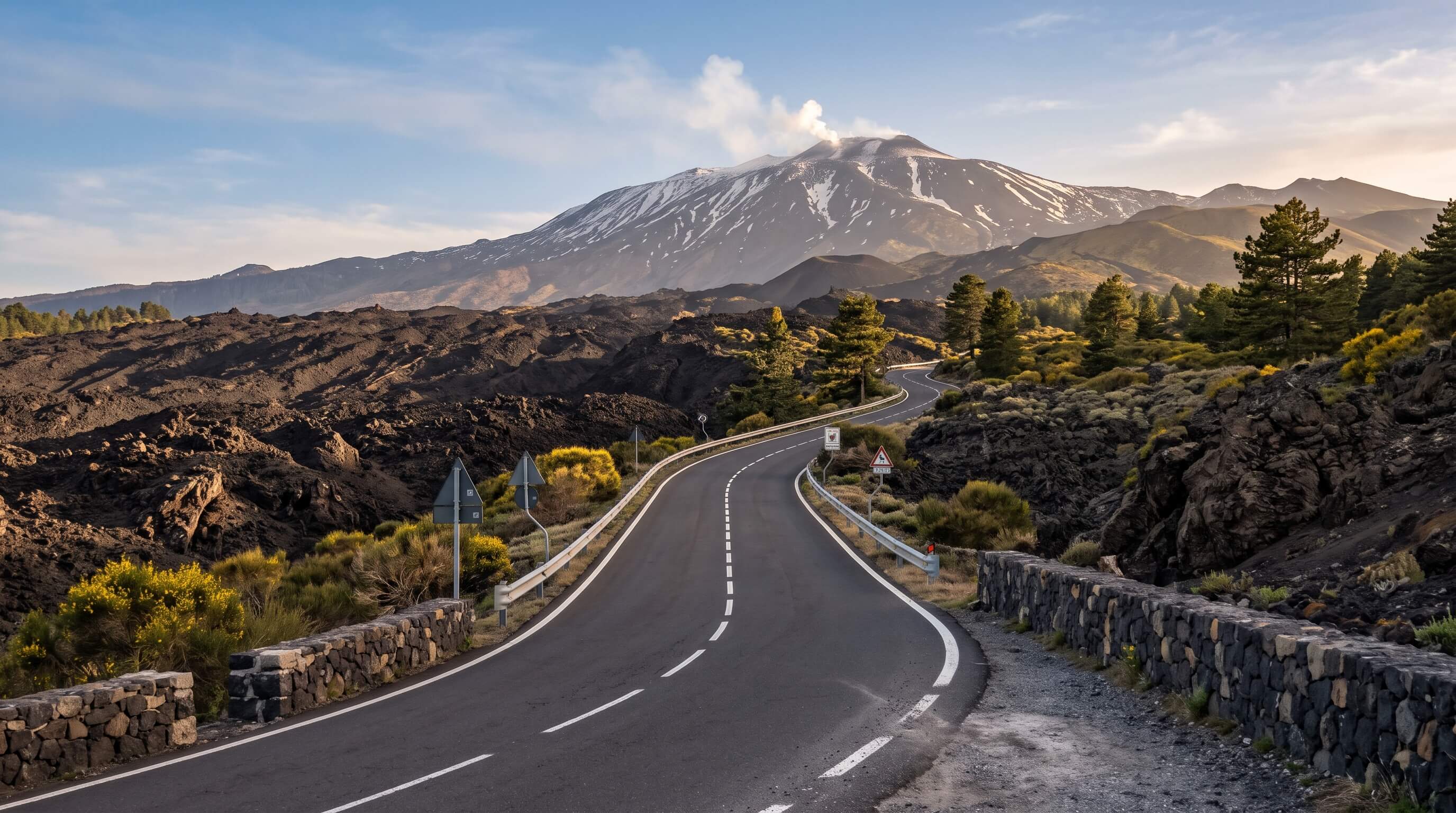
8. The Volcano Loop: SP92 Mount Etna
Route: Nicolosi – Rifugio Sapienza – Zafferana Etnea | Region: Sicily | Length: about 36 km
Mount Etna is one of the most active volcanoes in the world and the highest active volcano in Europe outside the Caucasus. Its height changes with its eruptions but stands at well over 3,300 m. It has been a UNESCO World Heritage Site since 2013.
The ride: The SP92 climbs from Nicolosi through black lava fields to Rifugio Sapienza at around 1,900 m, then drops down the other side to Zafferana Etnea, where the landscape turns green again. The road surface can be rough in places, and access to the upper slopes can be restricted during eruptions.
Worth stopping: The Silvestri Craters, formed in the eruption of 1892, which sit right beside the road near Rifugio Sapienza. From the refuge a cable car continues to around 2,500 m. Taormina and its ancient Greek theatre are an easy ride away along the coast.
Ride Them All
Eight rides, eight faces of Italy: Bourbon cliff engineering, Tuscan wine country, Habsburg mountain roads, a Bond film set, a Sardinian mountain road and a living volcano.
Find all of these routes and stops on the Scenic Rider map, download the GPX, and start ticking them off in your logbook.
Passes Mentioned In Story
Ready to ride these roads?
Explore these passes and our curated routes on our interactive 3D map.
Open Map Explorer